
A small apartment does not have to look like a storage unit with a bed in it. The rooms that feel generous are rarely the biggest ones — they are the ones where every piece has a job, every surface has breathing room, and the layout follows the way you actually live. Square metres matter, but decisions matter more.
This guide is for renters and owners working with a studio, a one-bedroom, or a single awkward room. None of it requires knocking down a wall. Most of it costs less than a new sofa, and all of it can be undone when you move.
Start with the floor plan, not the furniture
Before buying anything, measure the room and draw it on paper — including doors, windows, radiators, and the direction the door swings. Then mark the two or three routes you walk every day: bed to bathroom, kitchen to sofa, front door to desk. Furniture that blocks a daily route will annoy you within a week, no matter how good it looks.
Add the measurements you will actually need in a shop: wall lengths, the gap between the window and the nearest corner, the height of the radiator, the width of the door frame, and the diagonal depth of the stairwell. Photograph the tape measure against each wall so you do not have to guess later. A sofa that fits the wall but not the stairwell is a very expensive mistake.
The most common small-apartment mistake is pushing everything against the walls. It creates a wide empty centre that feels like a waiting room. Floating the sofa a few centimetres off the wall, or placing a low shelf behind it, can define a living zone without adding a single square metre.
Create zones without building walls
In a studio, the goal is not to pretend there are separate rooms. It is to make each activity legible. A rug under the seating area, a pendant light over the dining table, a tall bookcase used as a soft divider, a change in floor covering near the bed — these are enough to tell the eye where one zone ends and another begins.
Keep the circulation path clear between zones. In a room under 30 square metres, a 90-centimetre-wide walking route is comfortable; 60 centimetres is the minimum. If a piece of furniture narrows the route below that, it is in the wrong place.
Choose furniture that does two jobs
In a compact home, multifunction is not a gimmick. A storage ottoman replaces a coffee table and a blanket box. A wall-mounted drop-leaf desk becomes a dining table for two. A bed with drawers underneath can absorb an entire wardrobe's worth of off-season clothing. A slim console behind the sofa can hold books on one side and hide cables on the other.
The rule is simple: if a piece only does one thing, it needs to earn its footprint. That does not mean filling the room with convertible gadgets. A well-made sofa bed used every night is better than a beautiful sofa that forces you to store the guest mattress in the kitchen.
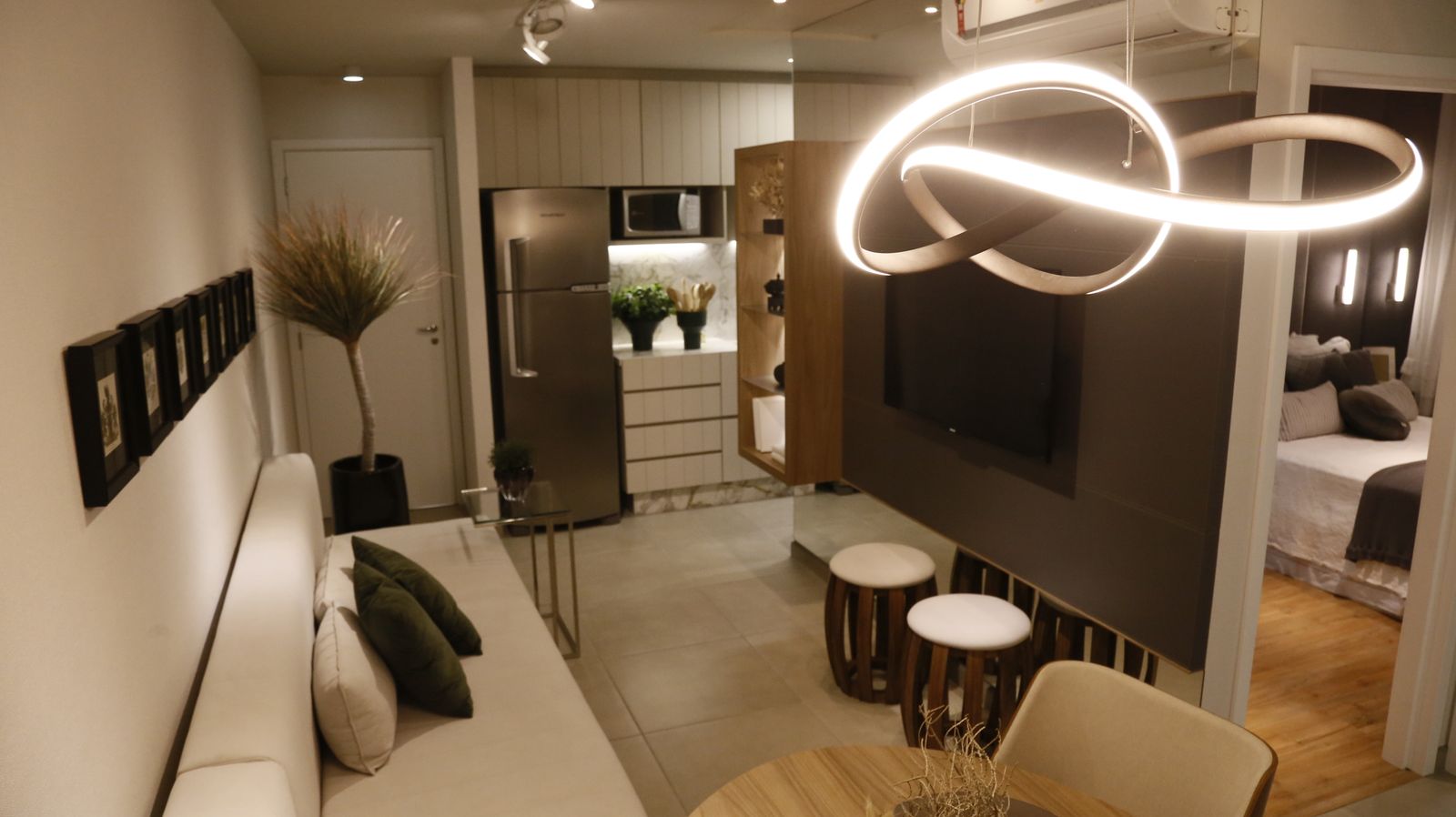
Photo: Vidal Balielo Jr. / Pexels
Audit storage before buying more of it
Most small apartments do not lack storage as much as they lack a storage system. Empty every cupboard once, group things by how often you use them, and be honest about what has not been touched in a year. Seasonal clothing, sports equipment and paperwork are usually the biggest offenders.
Then assign each category a permanent home. Beds with lift-up storage are excellent for suitcases and bedding. The space above wardrobes can take labelled boxes. The gap beside the fridge can take a slim pull-out trolley. Under-stairs and under-window areas are often wasted; a made-to-measure bench or a low cabinet can turn them into useful volume.
Vertical storage is the cheapest square footage in a small flat, but it needs restraint. Two or three deliberate vertical elements — one tall bookcase, one shelf run, one wall of hooks — will do more than a patchwork of storage cubes. A wall covered in small shelves reads as noise, not organisation.
Pick a calm base and one point of contrast
Small rooms benefit from a limited palette: walls, large furniture and rugs in two or three related tones, then one stronger accent that you actually love. This is not about beige minimalism. A deep green wall, a rust-coloured chair or a patterned runner can be the thing that makes the room feel designed rather than default.
Keep the darkest values low to the ground where possible — a dark rug or a dark sofa anchors a room without closing it in. Dark walls can work beautifully, but they need generous lighting and a clear view of the window. If you paint one wall dark, paint the adjoining walls in a lighter tone from the same family so the contrast looks intentional.
Repeat each colour at least twice. A single red cushion in an otherwise neutral room looks like a mistake; the same red repeated in a book spine, a small vase and a print looks like a decision. Repetition is what separates styling from clutter.
Let light do the work
Swap heavy curtains for something that can be pulled fully clear of the glass during the day. Avoid furniture that blocks the window. Add a mirror opposite or adjacent to the main light source, not to create a cliché, but because it genuinely doubles the visible depth of the room. A mirror behind a lamp can make a dark corner feel twice as deep.
At night, use two or three low-wattage sources instead of one overhead light. A floor lamp beside the sofa, a small lamp on a shelf and a warm bulb in a corner will make a compact room feel layered and intentional. Warm white bulbs around 2700K are kinder to wood, fabric and skin than cool white ones.
Use the walls for things that are not storage
Art, mirrors, a clock, a hanging plant, a wall-mounted bike rack — the walls are part of the room, not just the boundary of it. Hang artwork at eye level, roughly 145–150 centimetres from the floor to the centre of the piece. In a small room, one large work usually looks better than a cluster of small ones because it reduces visual noise.
If you rent and cannot drill, adhesive hooks and lightweight frames will handle most prints. For heavier pieces, a leaning shelf or a picture ledge distributes the weight without a single hole.
Deal with the things that never have a home
Every small apartment has a few items that resist organisation: the vacuum, the ironing board, the drying rack, the recycling. Solve these deliberately. A tall cupboard, a hook behind a door, a folding drying rack that mounts on the wall, a slim bin with a lid — none of these are glamorous, but they are the difference between a room that stays tidy and one that never quite does.
Also give the entry a landing zone: a hook, a tray, a small bench or a shoe rack. If bags and keys have nowhere to go, they will end up on the kitchen counter or the sofa, and the whole apartment will feel unsettled.
Edit, then edit again
The final step in every small-space project is subtraction. Clear the surfaces. Remove the chair that nobody sits in. Donate the second coffee table. A small apartment feels luxurious when there is visible empty space — on the floor, on the walls, and on the table where you put your coffee down.
A useful test is to take a photograph of each room from the doorway. The camera sees clutter more honestly than you do. Anything that looks messy in the photo but has no clear purpose is a candidate for removal or storage.
Decorating a compact home is not about squeezing in more. It is about deciding what each square metre is for, and protecting that decision.