
Most rooms are lit by one ceiling light and a lot of hope. The result is flat: everything evenly bright, no shadows, no warmth, no reason for the eye to move. Designers do not solve this by adding more light. They solve it by layering three kinds of light and giving each one a job.
The good news is that this is one of the cheapest upgrades in a home. It rarely requires an electrician, and it can be done over a weekend with lamps you already own plus one or two new ones.
Layer one: ambient light
Ambient light is the general wash that lets you move around safely — the ceiling fixture, a pair of ceiling spotlights, or a large pendant. It should be dimmable and it should never be the only thing switched on in the evening.
If you have a single central fixture, do not replace it immediately. Put it on a dimmer first. Being able to take it down to 20 percent changes the atmosphere more than a new shade will. A dimmer switch is inexpensive and can be fitted in minutes if the wiring supports it; plug-in dimmers work for lamps.
Ambient light should also be spread rather than concentrated. If the ceiling fixture is a bare bulb or a small pendant, adding a large shade or a diffuser will soften the light and reduce glare. In a rental, a paper lantern or a fabric shade over a pendant is an easy fix.
Layer two: task light
Task light is for reading, cooking, working and seeing what you are doing. A floor lamp beside the sofa, a swing-arm lamp over a chair, a focused pendant over the kitchen counter, a bedside light you can angle. This layer is what makes a room usable after dark.
Choose the height carefully. A reading lamp should sit roughly at shoulder height when you are seated, with the shade below eye level so the bulb does not glare. If you can see the bare bulb from your chair, it is too high or the shade is too shallow. A swing-arm lamp is more flexible than a fixed one because it can be pulled over a book or pushed back when not in use.
Task lighting should be bright enough to work by, but not so bright that it flattens the room. A 5–8 watt LED in a well-designed shade is usually enough for reading; the old habit of using the highest wattage available is what makes rooms feel clinical.
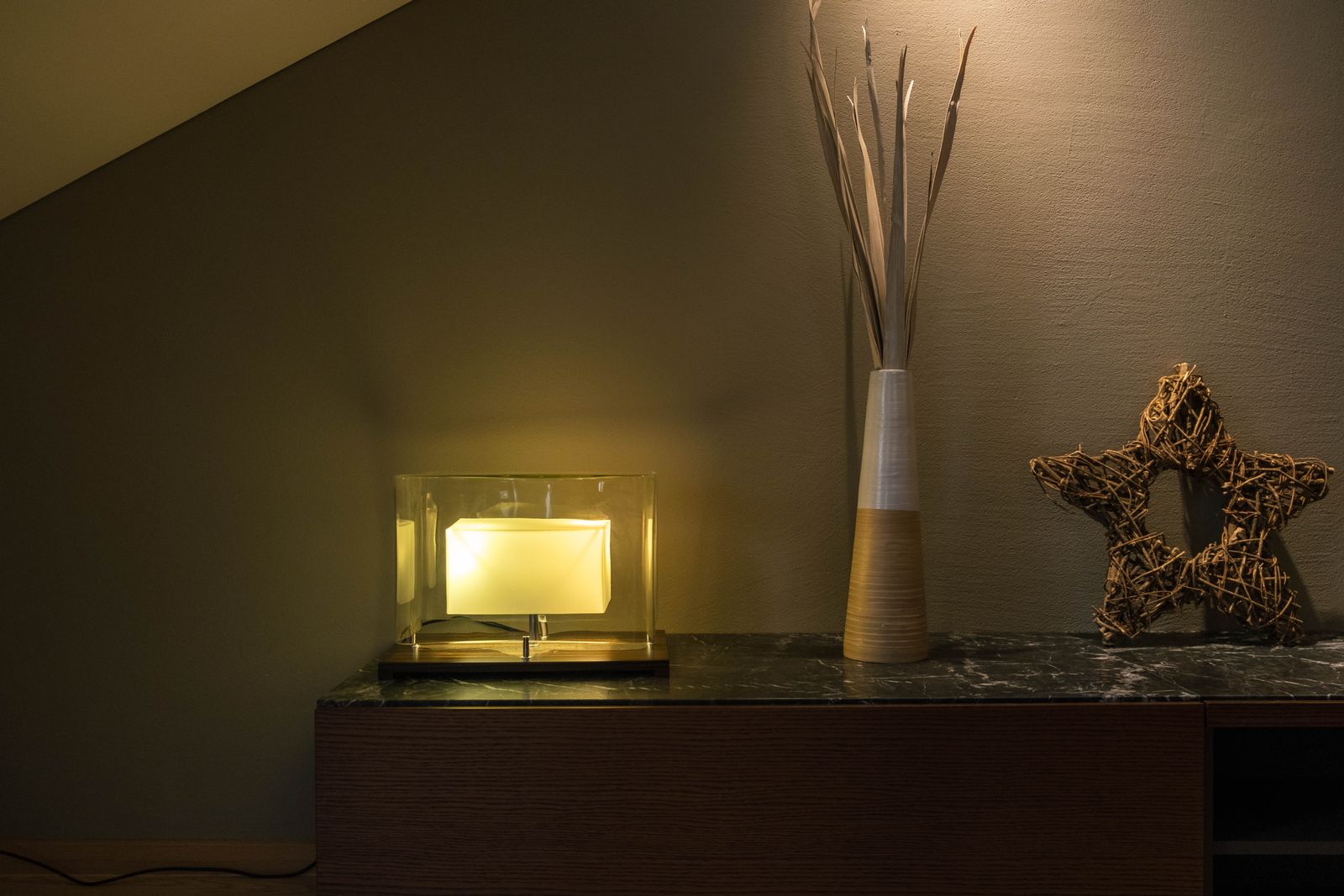
Photo: Nicholas Derio Palacios / Pexels
Layer three: accent light
Accent light is the layer that makes a room feel designed. It picks out a wall, a plant, a picture or a corner. A picture light above a print, a small uplight behind a plant, a slim sconce on a dark wall, a candle on the mantel. It adds depth, because it creates light and shadow rather than flattening everything.
Accent lighting is also the cheapest layer to add. One warm plug-in sconce or a rechargeable table lamp in a dark corner will do more than doubling the wattage of the ceiling bulb. Uplighting a plant or a tall vase casts soft shadows on the wall and makes the corner feel deeper than it is.
Keep accent light low-intensity. Its job is atmosphere, not illumination. If you can read by it, it is doing the wrong job.
Colour temperature: keep it warm and consistent
Look for bulbs around 2700K in living spaces and bedrooms. Cool white bulbs (4000K and above) are for garages, offices and utility rooms; in a living room they make wood look grey and skin look tired. Also make sure all the bulbs in one sightline match. A warm lamp beside a cool ceiling light is the fastest way to make a room feel unfinished.
Warm dimming bulbs are worth the small premium. They shift from a clean warm white down to candle-like amber as you dim them, which is exactly the transition you want between dinner and late evening. If you cannot find warm dimming, choose a bulb with a high colour rendering index (CRI 90+) so fabrics and wood keep their true colour.
Watch out for smart bulbs that default to cool white after a power cut. Set a warm default in the app, or you will find the room looking blue every time the switch is flipped at the wall.
Placement: light the walls, not the air
A useful rule is to light surfaces rather than the middle of the room. Light bounced off a pale wall or ceiling spreads softly and makes the space feel larger. A lamp pointed at a dark corner will lift it. A downlight aimed at the centre of the floor will not.
Try to avoid placing lamps directly in front of a window at night; the dark glass becomes a mirror and the effect is unsettling. Pull lamps slightly to the side so the window remains part of the composition. Similarly, a lamp placed in front of a mirror will double the light source and can look messy; offset it instead.
A simple upgrade plan
If you want to improve a room this weekend, do it in this order. One: put the main ceiling light on a dimmer. Two: add a floor lamp beside the main seating. Three: add one small accent light in the darkest corner. Four: replace every bulb in the room with the same warm white. Five: add a table lamp at the other end of the sofa so the room has two pools of light rather than one.
None of these steps requires an electrician, and together they will change the room more than a new sofa would. If you have a little more budget, the next upgrade is a picture light or a wall sconce, because it removes the need for a floor lamp and frees up floor space.
Use smart bulbs and dimmers sensibly
Smart bulbs are useful for creating scenes, but they are not a substitute for good fixture placement. A room with one smart bulb in the ceiling is still a room with one light source. Use smart bulbs in lamps that are already well placed, and set warm, low-intensity defaults for the evening.
Group lights so they can be switched together. Three lamps on three separate switches is annoying; three lamps on one smart plug or a single wall switch is practical. If you rent, smart plugs and battery-powered lamps avoid any wiring changes.
Keep a simple fallback: a physical switch that works without an app. Guests, children and anyone without the app should still be able to turn on the lights.
Common mistakes to avoid
Three mistakes account for most badly lit rooms. The first is relying on a single overhead light, which flattens everything. The second is mixing colour temperatures, which makes the room feel disjointed even when the furniture is right. The third is placing lamps too high or too low, so they either glare into your eyes or light only the floor.
Fix those three and almost any room will improve. Good lighting is not decoration; it is the difference between a room you use and a room you avoid after sunset.