
After years of painted white, lacquered grey and matte black, wood is back at the centre of interior design. Not wood-veneer cheapness or orange 1990s pine, but solid timber with visible grain and a finish you want to touch. The interesting part is not the trend itself but the way different species and finishes change the mood of a room.
Wood is also one of the few materials that improves with age. It responds to light, humidity and use, and it can be repaired rather than replaced. That combination is why it keeps returning even after decades of synthetic alternatives.
Oak: the reliable warm neutral
Oak is the workhorse of warm interiors. It is hard, plentiful and forgiving, with a grain that moves from subtle on rift-sawn boards to strongly figured on plain-sawn ones. Pale oak — especially white-oiled oak — lifts a room without making it feel cold. Smoked or fumed oak is darker and more dramatic, with a grey-brown tone that sits well against stone and linen.
For flooring or large furniture, white oak is the safer choice than red oak, which tends to run pink under warm light. If you are buying online, ask for a sample of the actual finish, not just the species. Oak also takes stain unevenly because of its open grain, so a factory finish is usually more predictable than a DIY one.
Walnut: depth without heaviness
Walnut has a chocolate-brown heartwood that makes a room feel settled. It is softer than oak and more expensive, but a single walnut piece — a sideboard, a dining table, a bed frame — can carry a room on its own. The risk is overdoing it: an entire walnut room can feel like a 1970s boardroom. Pair it with pale walls, linen and lighter woods.
Walnut also varies enormously between boards. A table made from the sapwood-rich edge of the tree will look very different from one made from the dark centre. Reputable makers show the actual piece or at least a representative sample. If you are ordering a large table, ask whether the boards are colour-matched.
The other species worth knowing
Ash is pale, hard and strongly grained; it looks like a more rustic oak and is often used for bentwood chairs. Beech is dense and even-grained, good for painted furniture and frames. Maple is pale and smooth, with a subtle grain that suits minimalist rooms. Cherry starts warm and darkens significantly with light, which is beautiful but hard to match later. Pine is soft and inexpensive; it dents easily and is better painted than left bare in high-traffic rooms.
If you want a warm, contemporary look without the cost of walnut, ash or white oak are the most reliable choices. If you want a traditional look, oak and pine are the natural defaults.
Grain direction is part of the design
How a board is cut changes what you see. Plain-sawn boards show wide, cathedral-shaped arches; rift-sawn boards show straight, quieter lines; quarter-sawn boards show a subtle ray fleck, especially in oak. For large surfaces such as table tops and cabinet fronts, straight grain reads calmer and more modern, while cathedral grain reads more rustic.
Good makers align grain across drawer fronts and door panels. Badly aligned grain looks like a patchwork even when the wood is expensive. When you are buying a piece with several drawers, check whether the grain runs continuously across the front.
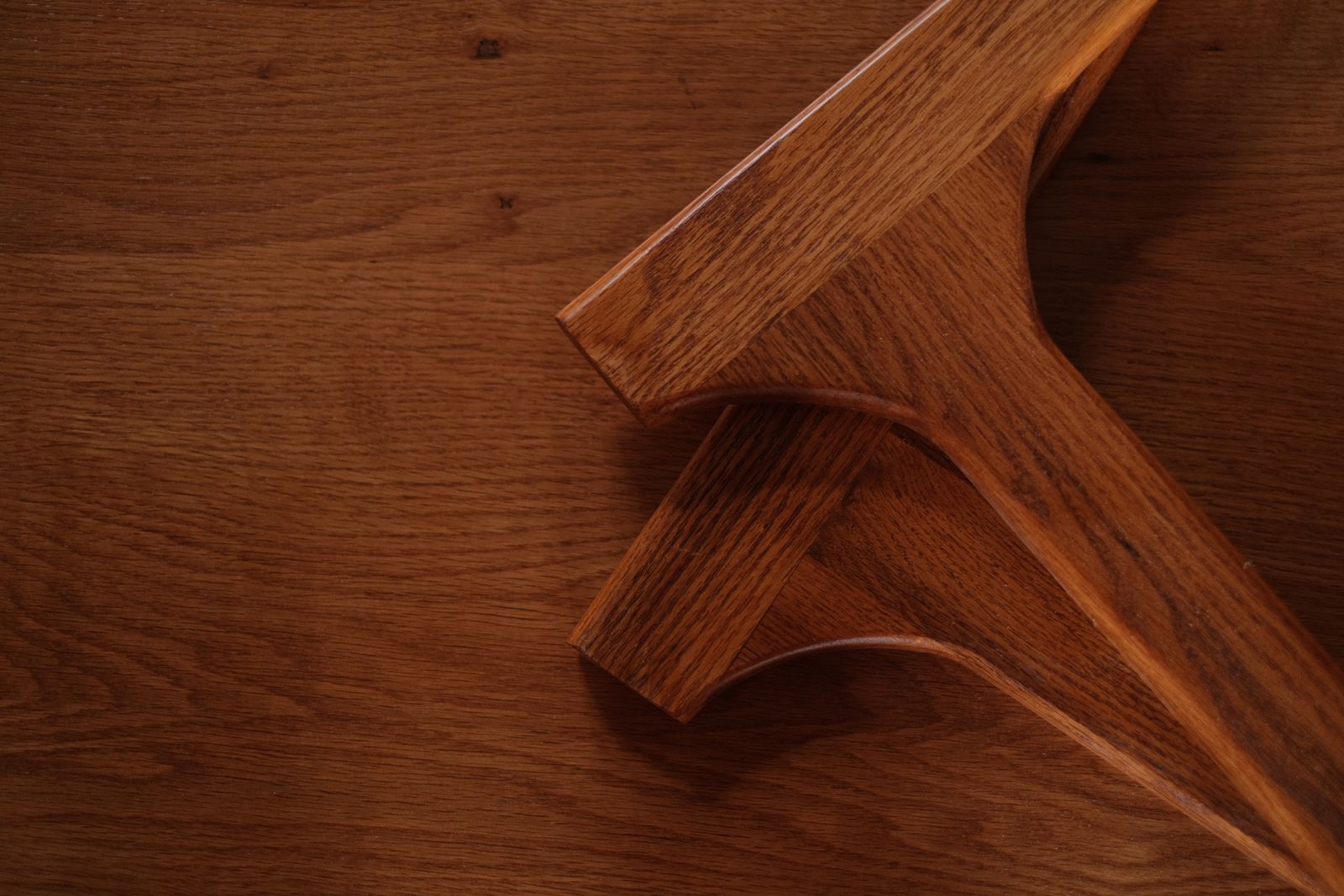
Photo: Pew Nguyen / Pexels
Finish changes everything
The same board can look Scandinavian, farmhouse or mid-century depending on the finish. Matte hardwax oil keeps the wood looking raw and is easy to spot-repair. Lacquer gives a smoother, more uniform surface and more protection. High-gloss is back in some design circles but shows every fingerprint.
For a warm, natural look, choose a low-sheen oil or soap finish. Avoid orange-toned stains and heavy yellow varnish; both date quickly and flatten the grain. If a piece is described as "honey oak" or "golden oak", it usually means a strong warm stain that will look very different from the pale oak in current interiors.
Solid wood, veneer and engineered boards
Solid wood is what most people think they are buying, but much furniture is veneered: a thin layer of real wood over plywood or MDF. Veneer is not inherently bad — it is more stable, uses less precious timber and can look excellent. The problem is cheap veneer that chips at the edges or repeats the same artificial grain across every panel.
Engineered flooring follows the same logic: a real wood top layer over a stable core. It is usually more dimensionally stable than solid timber and better suited to underfloor heating. Check the thickness of the wear layer; 3–4 millimetres can be sanded and refinished a few times, while a 0.6-millimetre layer cannot.
Mix species deliberately
A common fear is that different woods will clash. They usually will not, provided they share a similar warmth and you repeat each one at least twice in the room. A walnut table with oak chairs works when the floor or a shelf echoes one of the two. The mistake is introducing five unrelated tones in small doses.
If you are unsure, keep the floor and largest pieces in one family, then use a second wood for smaller items. Metal and stone can act as a bridge between them. A room with oak floors, a walnut table and black metal legs is easy to balance; a room with oak, cherry, pine, teak and mahogany is not.
Build a palette around the wood
Wood is easier to live with when the rest of the room supports it. Warm woods such as oak, walnut and cherry sit naturally with cream, olive, rust, chocolate and aged brass. Cooler woods such as ash and maple work well with grey, pale blue, black metal and white ceramic. Mixing a warm wood with a cold grey scheme can work, but it needs a bridge — a textile, a rug or a metal finish that appears in both camps.
Pay attention to the floor, because it is the largest wood surface in most rooms. If the floor is orange-toned, a pale oak table will look disconnected; if the floor is pale, a dark walnut piece will stand out sharply. A rug can separate the two and soften the contrast, which is one reason rugs are so useful in wood-heavy rooms.
Let it age
Wood changes. Cherry darkens, oak yellows slightly, walnut lightens in strong sun. This is not a defect; it is the reason solid wood feels alive in a way laminate never does. Use coasters, avoid leaving wet glasses on untreated surfaces, and re-oil every year or two depending on wear.
Keep indoor humidity relatively stable — roughly 40–60 percent — to reduce movement and cracking, especially in winter when heating dries the air. Small cracks in solid timber are normal; large gaps at joints are not. The return of warm wood is really a return to materials that improve with time. In a market full of disposable furniture, that is worth paying attention to.