
Every traveller knows the sequence. You check into a hotel, sleep better than you have in weeks, wake up convinced you have finally understood something about your own bedroom — and then you get home, lie down, and the spell breaks within a night. The mattress is too soft, or too old, or simply not what you spent the last three nights on. The pillow is wrong. The sheets do not have that crisp, slightly cool weight.
The usual explanation is that hotel beds are expensive. That is only half true. Hotels buy in volume, replace on a schedule, and — crucially — build a system: a firm core, a soft topper, tightly fitted linen, a bed base that does not flex. What you are missing at home is rarely one object. It is the combination. And it is exactly that combination that Morphea, a Paris-based sleep brand, has built its business around.
I spent a morning in their showroom in the 9th arrondissement and several weeks reading through the catalogue, the delivery terms and the fine print. What follows is what the brand actually is, what it does differently, and — just as importantly — who it does not work for.
What Morphea Actually Is
Morphea was founded in Paris in 2020 by an entrepreneur who had spent years in the hotel business. The founding observation was simple and slightly unglamorous: hotels know how to make a bed feel good, and most people do not. The company's answer was to sell the hotel formula directly — mattresses, beds and bases, bedding, pillows and toppers — without the showroom mark-up that traditionally sits between a factory and a bedroom.
The operation is entirely French. The offices and the customer service team are in Paris, the logistics warehouse is in Savigny-le-Temple, southeast of the capital, and the after-sales address is a normal French email that gets answered by a human within 24 to 48 working hours. The company also runs a professional arm, sold to the hospitality trade under the banner Le confort hôtelier by Morphea, which is the most useful thing to know about the brand: the mattresses are not designed for a furniture shop window. They are designed for people who will spend eight hours a night on them and complain if they are wrong.
The numbers the company publishes are modest but specific: more than 50,000 customers, a stated 97% satisfaction rate, and a review count on the flagship mattress in the low hundreds rather than the tens of thousands. That is a useful signal in a category where inflated review totals are the norm — this is a mid-sized French brand, not a global marketing machine.
Why Hotel Beds Feel Different
The central idea in Morphea's range is the hybrid mattress: pocket springs for support, layers of foam for pressure relief, and — on the flagship model — an integrated topper stitched into the top. That last detail is the one that explains the hotel feeling. A hotel bed is rarely one firm surface. It is a supportive base with a forgiving top layer, so you sink in just enough at the shoulder and hip without losing the support underneath.
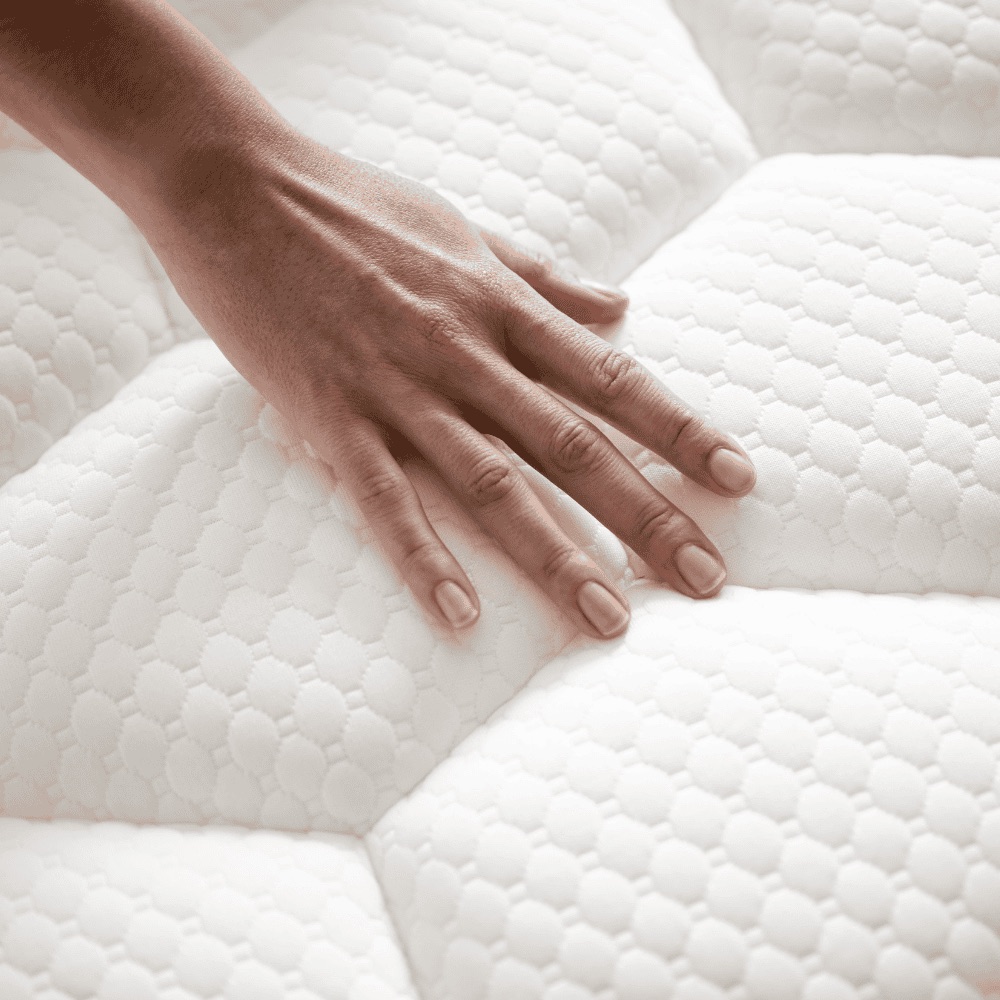
The foams are the company's own: Air Memory for the memory-foam layer, Ergo Feel and Comfort Feel for the support and recovery layers. The products carry OEKO-TEX certification, and some models use recycled organic cotton. None of this is unusual in isolation. What is less usual is finding it at these prices, in a range small enough to choose from without a spreadsheet.
The same logic runs through the bedding. Morphea sells percale cotton sheets, duvets, coverlets and decorative cushions — the tight-weave, slightly crisp percale that hotels use, rather than the brushed flannel softness that many domestic ranges favour. If you have ever wondered why hotel sheets feel cool and smooth on the first night and your own feel heavier, the weave is usually the answer.
The Mattress Range, Honestly
There are five mattresses in the current range, which is a relief after the hundred-model catalogues of the big French furniture chains. The two that matter for most people are the Victoria and the Jade+.
The Victoria is the flagship: 30 cm thick, with an integrated topper, a soft-medium feel and a design aimed at couples who disagree about firmness. It is the one the company pushes hardest, and it currently starts at €389.99 against a list price of €769.99. The Jade+ is the firm option — 26 cm, a tighter, more tonic feel, aimed at back sleepers and anyone who finds memory foam too enveloping. It starts at €309.99, down from €499.99.
Below those sit the Mila, a semi-firm entry model, and above them the Victoria+ and the Diana, which move into the €900–€1,000 bracket at list price. The whole range is available in French sizes from 90×190 up to 200×200, which is worth flagging for anyone arriving from the United States or Britain: a French 160×200 is not a US queen, and a 200×200 is not a king. Measure the frame before you order, not after.
The pricing deserves a caveat. Morphea runs promotions almost continuously — at the time of writing the site was in the middle of a "Black Month" campaign with discounts up to 50% and an extra 10% off with the code BLACKMONTH10 on the French-language site. Treat the crossed-out price as a marketing maximum, not a reference point, and judge the mattress on the price you can actually pay. The current offer is genuinely competitive for a hybrid mattress with an integrated topper; the list price is not what anyone should expect to spend.
You can see the current models, sizes and prices on Morphea's mattress range.
The Part Nobody Talks About: the Base and the Storage
A mattress on a bad base will feel like a bad mattress, and Morphea sells the base as part of the system. The CÉLIA is the most interesting object in the catalogue: an upholstered storage bed with a lift-up mechanism and roughly three square metres of space underneath — enough for suitcases, spare bedding and the seasonal clutter that otherwise ends up in a wardrobe. It comes in velvet in latte, cappuccino or espresso, or a heathered off-white fabric, and starts at €849.99 against a list price of €1,399.99.
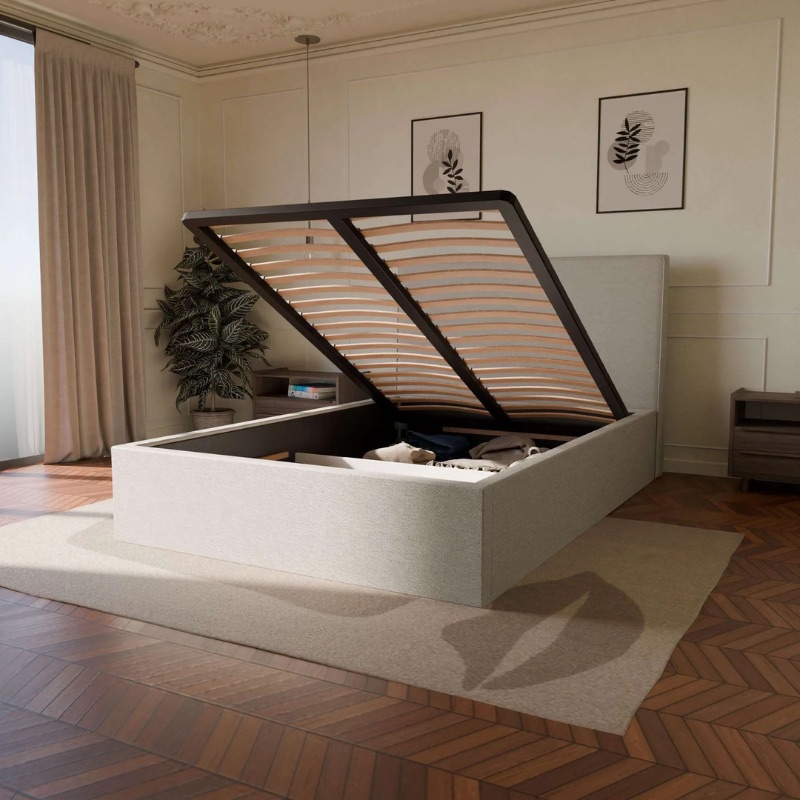
For anyone furnishing a bedroom from scratch, the packs are the sensible route: the CÉLIA and Victoria together start at €1,494.99, down from €2,299.99. There is also the SERENA sofa, a rounded, enveloping piece in the same fabric family, at €799.99. The logic throughout is coordinated softness — the same palette, the same velvety textures, the same slightly retro Parisian calm.
This is where the brand is most convincing as a system rather than a mattress shop. If you have ever tried to match a bed base to a mattress to a set of sheets across three different retailers, the appeal of buying the whole room from one French cart is obvious.
What Sleeping on It Is Like — and What Happens If You Don't Like It
The terms are the part that separates a serious direct-to-consumer brand from a website with good photography. Morphea offers 100 nights of trial on its mattresses. If it is wrong, you send it back at no cost — no return fee, no cancellation charge — and the company will also take away your old mattress if you want it gone. The take-back is handled through a French recycling partner and is limited to mainland France, but for anyone moving into a new flat it removes the single most annoying logistical problem of buying a bed.
There is also a 10-year warranty on the mattresses, a detail worth reading carefully: it covers manufacturing defects and replacement, not a cash refund, which is the industry norm but rarely stated this plainly.
The company's own figures suggest the trial is not just marketing. The Victoria carries more than 400 reviews, the Jade+ more than 360, and the CÉLIA close to 90 — modest numbers by marketplace standards, but the kind that accumulate when a product is actually being used rather than reviewed on delivery day.
The Practical Bits: Delivery, Sizes and the Language Problem
This is where the French reality bites, and it is better to know now.
Standard delivery is free to France, Corsica, Belgium and Luxembourg, with in-home delivery and installation available as paid upgrades. Delivery to mainland France takes roughly three to seven working days, on weekdays. Morphea does not ship to the United States, Britain, Germany or most of the rest of Europe. If you are reading this from New York or Manchester, the brand can still be useful as a reference point — but you cannot order from it.
The website is French-first. There is an English version, but it is only partly translated: product names, filters and some descriptive copy remain in French. Customer service operates in French, Monday to Friday, 9am to 5pm Paris time, at [email protected]. None of this is a dealbreaker if you are comfortable with French or willing to use a browser translator, but it is a different experience from buying from a brand with a fully localised checkout.
Payment is flexible — three, four or up to 24 instalments — and the checkout is a normal Shopify flow. The showroom is at 9 bis rue de Maubeuge, 75009 Paris, two minutes from Cadet on line 7, with a private "sleepbox" where you can lie on the mattresses properly rather than perching on the edge. Check the opening hours before you go; the showroom is a working space, not a flagship store with set retail hours.
The Paris Showroom Is the Real Reason to Care
For a traveller, the most interesting thing about Morphea is not the website. It is that the brand has a physical room in Paris where you can test the entire system — mattress, base, topper, pillows, linen — in something close to hotel conditions.
If you are planning a trip to Paris and your bedroom at home is due a reset, this is a genuinely useful hour. You can lie on the Victoria and the Jade+ back to back, feel the difference the integrated topper makes, and decide whether the CÉLIA's storage capacity is worth the extra height. The showroom sits a short walk from Gare du Nord and Gare de l'Est, which makes it easy to combine with a Eurostar arrival or a train south. It is also, frankly, a more pleasant way to spend an hour than another museum queue.
The catch is the same as the website's: you need to be able to receive a delivery in France, Belgium or Luxembourg. If you are furnishing a flat in Paris, Lyon or Brussels, that is exactly the point. If you are visiting from farther away, the showroom is research, not a purchase.
Verdict: Who It Suits
It suits: anyone furnishing a home in France, Belgium or Luxembourg who wants a hotel-style bed without hotel prices; couples who disagree about mattress firmness; people who need storage under the bed and do not want to sacrifice the look of an upholstered frame; and travellers who want to test a mattress properly before buying, in a city they are already visiting.
It does not suit: readers in the US, UK or Germany who need delivery to their door; anyone who wants a fully English-language purchase journey; and anyone who needs a custom or non-European bed size. The promotion-led pricing also requires a certain tolerance for sales theatre — the list prices are there to be crossed out.
What stayed with me after the showroom visit was how ordinary the underlying idea was. Hotels have been buying beds this way for decades: firm core, soft top, tight linen, a base that does not move. Morphea has simply taken that formula, removed the trade-only layer, and priced it for people who are not refurbishing forty rooms. The result is not a luxury object. It is a very good bed, sold with unusually clear terms, in a country that takes sleep seriously enough to put a showroom in the middle of Paris.
If you are within delivery range, the current range is worth a proper look — and if you are planning a trip to Paris, the showroom is worth an hour of it.