
The entryway is the first room you see and the last one you leave, yet it is usually the smallest and least considered. It tends to become a dumping ground for shoes, keys, post and bags — a place where things land rather than a place that welcomes. A few practical decisions can turn a corridor into a room that works.
The order matters: solve storage first, lighting second, decoration last. A beautiful console covered in unopened post will never look styled, no matter how carefully the objects were chosen.
Solve storage before styling
Start with what actually arrives at the door: shoes, coats, keys, post, bags, a dog lead. If those things have no home, the entryway will never look tidy, no matter how many decorative bowls you put on the console.
The essentials are usually a narrow shoe rack or a lidded bench, a row of hooks at the right height, a tray or small dish for keys, and a basket for post. Keep the floor as clear as possible; in a narrow hall, every centimetre of floor space matters. A floating shelf above the hooks can hold hats, gloves and a small basket for odds and ends.
Hooks should be around 150–170 centimetres from the floor for adults, lower at 100–120 centimetres for children. A double row of hooks uses the height of a hallway well: high hooks for coats, low hooks for bags and kids' jackets.
Choose a console that fits the wall
A console table is the default entryway piece because it provides a surface without blocking the walkway. Aim for a depth of 30–35 centimetres in a narrow hall; anything deeper becomes an obstacle. If the hall is too narrow even for that, use a wall-mounted shelf or a slim mirror with a small ledge.
Mount the console on the wall rather than relying on legs where possible. It looks lighter and makes the floor easier to clean. If you need storage, choose a console with drawers or a lower shelf for baskets rather than a solid box that visually fills the hall.
In a very narrow corridor, a shallow wall shelf at waist height can do the job of a console. Add a small hook underneath for keys and you have a complete landing zone in less than 25 centimetres of depth.
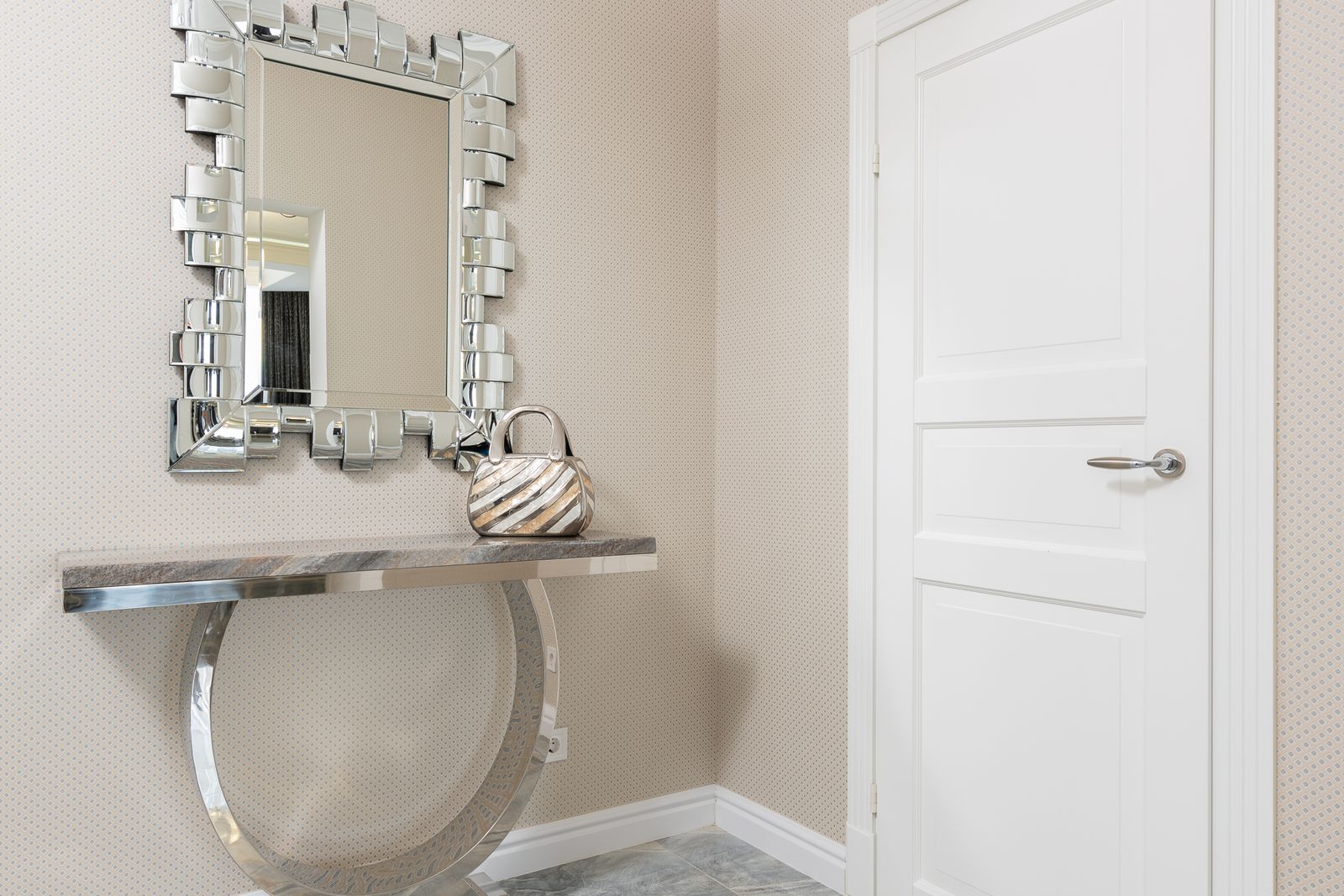
Photo: Max Vakhtbovych / Pexels
Light it properly
Entryways are often the darkest room in the house because they have no window and rely on a single overhead bulb. Change the bulb to a warm white and add a small lamp on the console if there is space. A table lamp makes the arrival home feel much more welcoming than a harsh ceiling light.
If there is no socket, a rechargeable lamp or a battery-powered picture light works well. The entryway is one of the few places where a decorative light can be purely atmospheric. A mirror opposite the lamp will double the glow and make the hall feel warmer.
Consider a motion-sensor light for late arrivals. It is practical, and it avoids fumbling for a switch with your hands full.
Use a mirror — but place it thoughtfully
A mirror makes a narrow hall feel wider and gives you a place to check your appearance before leaving. Place it opposite something worth reflecting: a plant, a piece of art, a window. A mirror that reflects a blank wall or a pile of shoes does not help.
In a small hall, a large mirror is usually better than several small ones. Scale matters more than quantity. Hang it so the centre is at eye level, roughly 145–155 centimetres from the floor, or lean a full-length mirror against the wall if you have the floor space.
Choose a durable floor covering
The entryway takes more foot traffic than almost any other room. A washable runner, a coir mat or a flat-weave rug is practical and adds colour. Avoid pale, high-pile rugs that show every footprint and trap grit.
Put a coarse mat outside the door and a softer one inside. The outside mat removes the worst of the dirt; the inside mat absorbs moisture and protects the floor. Shake them out weekly and wash them when they start to look tired.
Style the surface with restraint
The console is a working surface, not a display cabinet. A tray for keys, one decorative object, and perhaps a small plant or a lamp is enough. Leave space for the post you are about to put down. A crowded console becomes a horizontal junk drawer within a week.
Choose a tray with raised edges so keys and coins do not slide onto the floor. It is a small detail that makes the whole arrangement feel intentional. A bowl for keys works well if it is deep enough to hold a wallet and sunglasses as well.
Deal with coats and shoes honestly
Coats are bulky. If the hall has a cupboard, use it, but make sure there is a hook for the coat you wear every day. If there is no cupboard, a wall-mounted rail or a row of hooks is more practical than a freestanding coat stand that tips over when loaded.
Shoes need ventilation and a place to dry. A slatted rack or an open basket is better than a closed box, which traps moisture and smell. Keep the number of shoes in the hall to what is actually worn this week; everything else belongs in a bedroom cupboard.
Adapt the layout to the shape of the hall
A long, narrow corridor works best with a shallow console on one wall, a runner on the floor and hooks on the opposite wall. Keep the far end clear or place a mirror there to make the corridor feel longer. Avoid placing furniture on both sides unless the hall is at least 120 centimetres wide.
An L-shaped or square entryway can take a corner bench with storage underneath, which is more comfortable for putting on shoes than a standing console. If the front door opens directly into the living room, use a rug, a slim shelf and a change in lighting to mark the transition rather than trying to build a wall.
In a very small flat, the entry might be a single wall beside the door. In that case, focus on one vertical strip: hooks at the top, a shelf at waist height, a shoe rack at the bottom. A narrow strip used well looks better than furniture squeezed into a space that cannot take it.
Add one thing that says something about you
An entryway is a transition space, but it is also the first impression of a home. A framed print, a photograph, a piece of art from a trip, a favourite colour on the wall. It does not need to be expensive or important. It just needs to be yours.
The best entryways are not the most decorated ones. They are the ones where the practical things have a place, the light is warm, and there is a clear sense that someone lives here and is glad to be back.